~border~

headernacouk2


january Rosemary
This is part of my rosemary hedge which is a few years old now. My original intention was to completely surround half a bed and grow carrots there every four years, but I have never finished it off. Rosemary repels carrot fly which almost always sniff out an unprotected crop. Each year I successfully add a few new plants but cuttings take time to develop, both in potting them up and in waiting for them to mature. I start cuttings off by standing them in water until a root structure forms, as in the photograph..

I have managed to grow them from seed this year for the first time but await to see if the tiny seedlings survive the winter. One year I hastily ripped out the corner of the hedge trying to save the rest of the hedge from disease. Unfortunately I worked out later that the scarred foliage was as a result of intense cold on the corner. It is frost hardy but only down to -5° C .

I was told it is difficult to grow so I thought about its home territory -Mediterranean hillsides- and prepared a stony subsoil for its roots to penetrate. I collect stones from the plot specially, as they surface, keep them until I need them, putting them into a trench about a spit (spade) deep.


~Rosemary with roots after standing in water~

Rosemary cutting


january Sage
When I moved the sage to the brassica bed in spring the scent was so pungent that Dave picked it up two plots away. I cut it back to about 15cm and chopped it down the middle into a few smaller clumps. One of the plants was impregnated with couchgrass. After an unsuccessful attempt to remove it last year I decided against throwing the sage away, opting for a root and branch approach to the problem, to make sure. I’m pleased to say the ruthless method worked a treat and the couch grass is no more.

Sage can be propagated from the new growth in June but it’s relatively easy to grow from seed, so I do this every so often. Common Sage ( salvia officianalis) will grow if scattered in a 15cm pot filled with compost & grit and then picked out when small individual pots using the pointed end of a plastic label. In thgis instance the big potful of compost may be reused in the smaller ones.


~sage~
Sage in flower


january Thyme
Now if you haven’t got thyme I have. I’ll tell you how to create it out of nothing. Well actually it comes from the seeds of thyme. You are especially well placed if you are a woman, because it waits for no man. They say there’s a thyme and a plaice, but I don’t agree I think there are other herbs which show a greater affinity with fish. Thyme is added with Coq au vin, a sprig doesn’t go amiss with pork, perhaps stuffed with apples and black pudding, and a confit of duck may be cooked on a bed of the gorgeous stuff. Together with sprigs of parsley and a bay leaf it forms the often used bouquet garni. What better than to pick all three fresh just before dropping them into that tasty dish.


january The Ancient Egyptians used it as part of embalming oil, and the Romans, aware of its medicinal value, spread it with their empire to northern Europe. There’s another thing we got from the Romans. The lovely little flowers are attractive to bees, which aid fertilisation, like all the labiatae family which includes mint, lavender and rosemary.


~Thyme~
Thyme in flower


january Coriander
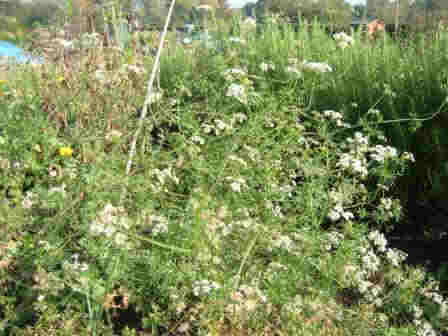
This wonderful herb is a bit of a contradiction. We associate it with exotic places, perhaps because it figures in eastern and far eastern cuisine. However it does not like dry conditions at all and in such weather will invariably run to seed. Not to worry, there is usually some coming up somewhere else providing you know what it looks like and leave it to develop. Once the leaves are large enough to rub or pinch with finger nails the smell is a pleasurable instant recognition.

january I discovered very early on that it definitely does not like to be shifted. So it does need to be planted in situ. I read that if you buy the branded seeds it is more resilient to drought and better quality, but I’m not looking to win prizes, and although I use a lot more than I probably would if I had to pay for it, the amount is still not large enough to worry about the yield or durability.


~Coriander in flower, running to seed~
Coriander in flower, running to seed


january Basil
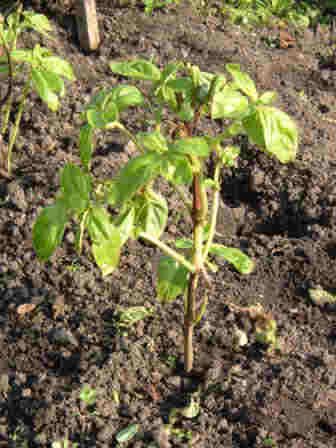
Basil is a must for anyone who likes food. Fresh leaves ripped up into pieces spread into any tomato sauce enhance it. In fact tomato and basil sauce is a brilliant light vegetarian accompaniment to pasta, especially if you add some fresh chopped green chilli. Since it is the main ingredient of pesto sauce this is another reason to grow it. Home made pesto is also tasty enough to accompany a pasta course or to make a light meal or lunch during the summer.

Like many other herbs, once the weather is warmer in spring, I plant seeds in the conservatory in a 15cm pot of compost. While they are still small I pick them out, by using the pointed end of a plastic label, into small pots of compost and let them establish themselves. Finally when they look big enough to take care of themselves and frosts a thing of the memory, I plant them out onto the plot. They are a bit fussy because they don’t like too much water and they don’t like too little. Outside they are best left alone unless there is a drought. In case disaster strikes outside I plant some singly into 15cm or 20cm pots for the window sill. It’s claimed that flies don’t like the smell, they prefer things like decaying flesh and manure. Certainly a row of six plants in our conservatory seemed to keep them at bay. No flies on me!


~Wild Rocket~
Wild Rocket
january Flat Leaf Parsley
I sow the seed outside but they are prey to slugs & snails which latch onto them as they come through and will easily see off whole rows at a time. Therefore it’s best to plant some indoors too, especially for an early crop. I use the same technique as with lettuce, in fact I plant it at the same time: four to a small pot towards each corner of the pot. Then there is no need to thin for they grow away from each other when moved out. It would be fine to scatter the seed outside but I tend to plant in rows so I know where it is when it comes through. Also it’s easier to water a row of seeds to keep the seeds damp so there is no delay in them germinating.

january For flavour, as much as I would like to disagree with everybody else, it has got to be flat leaf, either French or Italian. In fact I bought my current seeds in France while on holiday, together with a number of lettuces. Curly is an attractive garnish, so it’s worth sowing a few. As for flat leaf I like to have a solid mass of it. It’s a real pleasure to be able to cut a big bunch of it and, like rocket, it’s a great basis for all kinds of tasty dishes.


~Welsh Onion~
Welsh Onion


updated april2007 this month: what to do updated every month next month: what to do updated every month a fresh, detailed, topical item of interest updated every month fellow plotdiggers share their pictures with us weeds: common annuals& perennials
content and photos updated every month practical details on how to begin Crop Rotation Companion Planting herbs
slugs and snails fellow plotdiggers share their pictures with us recipes from our chefs Basil and Doyle photo review of the year Seeds from France


headernacouk2


If you like something special Chives, Basil, Thyme Sage and French Flat Leaf Parsley form the “Bouquet Garni” combination which is available from my website www.seedsfromfrance.com. Five packets for just £7.50 with free UK delivery.
Seeds from France

~Rosemary~

Rosemary hedge


january In medieval times they thought diseases spread by smells (well, they were nearly right) and so tried to counteract the plague by filling braziers with pungent substances such as rosemary to purify whole streets at a time. Individuals also carried around a bag of aromatic substances like rosemary and sniffed at it constantly to avoid catching the plague. (well it worked sometimes).

Rosemary and sage are reputed to be mutually beneficial, but I tend to shift the sage around so it can be close to the brassicas.

To get a decent bush of it I cut it right back in spring to about half a metre. I always intend to let it flower, but I usually tire of waiting and give it a good hacking. Last year having kept a bit for the kitchen I made a lovely fragrant carpet on the adjoining walkway which obligingly kept it weed free this summer.

This winter I have extended this idea with the decapitated Asparagus ferns, and the prunings from the Wild Rocket, which, being a perennial, I cut right back to within 15cm or so of the ground.


~Sage~
Sage


january Its latin name salvia comes from ‘salveo’ which means ‘to heal’, since some of the many types of thyme were used as medicines. Hence the saying ‘thyme is a great healer’. Apparently the Greeks used it as a remedy for ulcers and consumption.

The reason I move it each year to be with the brassicas is that it is reputed to repel the cabbage white butterfly, but so many other pests seem to arrive it’s hard to maintain the effort. I wish I could find something to repel whitefly, because the poor sage gets infected too. It is advisable to keep sage away from concurbits because the roots of cucumbers and courgettes are adversely affected by a chemical produced by the roots of the herb. We don’t use it much in the kitchen, although it is a main ingredient in stuffings, but if ever there is any doubt about the worth of growing it, just seeing the flush of purple when it in flower is more than enough reason.


~Sage grown from seed this year~
Thyme grown from seed this year


january Considering it helps to enliven so many recipes it’s just as well that it aids the digestion. It also has an internal antiseptic effect as it has antibacterial qualities and so thyme is good for the gut. I grow common thyme (thymus vulgaris), because we have lemon thyme(thymus citriodorous) in the back garden. This goes well with fish. I love the latin names, in this case look how it translates as ‘thyme with the smell of lemon’. It’s like when you go to the doctor with a bad back and you find it reassuring to be told that you have pain in the lumbar area.


january Once it is warm enough I plant seeds in the conservatory in a 15cm pot of compost. They readily pop up all over the place. While they are still small I pick them out, by using the pointed end of a plastic label, into small pots of compost and let them establish themselves. Finally when they look big enough to take care of themselves I plant them out onto the plot. The one in the above photograph is this year’s. Next year it will bush out and in succeeding years I will split it in spring by chopping it with a spade and shear it back to about 10cm. Thyme doesn’t always like this treatment, but it’s better than letting it go “leggy”.


~Coriander~
Coriander


january I’ve never bought coriander (coriandrum sativum) seeds, I inherited some and then just kept the seed. I did notice in the meantime that the seeds sold for culinary use were better value, but I’ve never bought any. I do save the seed by placing the dry heads in a bag & shaking – the heads, not me! Then I plant some of these fairly early under fleece to try to get an early crop, but coriander is not frost hardy. Of course some recipes need the seed anyway, either whole or ground in the pestle & mortar. Needless to say we are well supplied. One point to watch is not to grow it or let it grow near fennel for they inhibit each other’s growth.

january As an umbellifer the coriander’s small flowers are highly sought after by nectar gathering insects, so there is another reason to grow this lovely herb – wonderful.


~Basil~
Basil


january Wild Rocket
Wild Rocket is irrepressible. You have to plant some seeds, but after that you’re away. It just takes off. Well it would, wouldn’t it, with a name like that? Not to everyone’s taste as it stands up to be counted, but it certainly is to mine. Peppery doesn’t do it justice, it just bursts with flavour, and is a constant addition to any assembly of salad leaves.

I started off growing cultivated rocket but once it seeded itself it tasted too cabbagey, too strongly green. Then I tried wild rocket and I have never looked back. It’s prolific and to my surprise, it’s perennial. I only realised this when I neglected to remove some and it began to grow early the following spring. Some of mine is almost as thick as the wood on a bush. I just prune it back once it stops growing. Obligingly it doesn’t last forever, though, as when it’s a few years old it rots and disintegrates with the onset of winter. I consolidated mine on a small bed and resolved to remove it everywhere else it comes up. Of course I don’t, why would you? Come to think of it, is it a herb? I don't think it is.


~Parsley~
Parsley


january Parsley will overwinter but it gets a bit sad so I think it’s better to start anew each year, especially as if it does get diseased it might affect some of the other plants and/or next year’s growth.


january Welsh Onion
Welsh Onions are an interesting addition to the plot that, once established , tend to look after themselves. I have mine growing next to the rhubarb on a small bed next to the shed. They self seed prolifically, and I have also collected the seed to enable me to stagger the growth. They may be used as salad onions when small, or equally the foliage is a tasty alternative to chives and can be similarly chopped into a salad. It’s taken a couple of years to establish this degree of growth, but next year I should be able to make extensive use of it. If there are large clumps they should be divided into smaller ones, which also propagates them and adds to those developing from seeds.


Click here to view a chart of
companion planting herbs:


companion planting chart for herbs


Isn't Walter a star? Any questions or comments? Don't get in a flap, send an e mail winging its way to me.
Click Walter to contact me

URL http://www.digmyplot.co.uk
©january 2006