In 'Dig This' I look at a specific item of interest in detail. This month it is about my experience with Horsetail
Pernicious hardly does credit to this, the worst of all the weeds. A perennial, once established it is impossible to eradicate since it regenerates itself from any tiny part of the root or rhizome. Those who have suffered the similar effects of couchgrass and bindweed may disagree about which is the worst, but in my opinion horsetail wins hands down. I reckon it’s impossible to get out, mainly because it goes down so deep, but also because it stores nutrients in little nodes on the rooting system. It sends up shoots which spread laterally in all directions. Since it penetrates way below the topsoil it is impractical to dig it out since to do so would contaminate the topsoil, even supposing you could dig down deep enough. One Sunday afternoon, Alex, a neighbouring plotholder, set out to do this. Two hours later only his head and shoulders could be be seen. Needless to say he gave up the undertaking, so I would not advise his degree of commitment. Know when you're beaten.
Horsetail Meadow 2005
Horsetail Meadow 2005
When I took over my new plot in 2005 it was so riddled with it that during the summer months nothing else would grow. It was literally a meadow of horsetail. Below ground at about 12 inches down lateral rhizomes shot off in all directions making a matted, almost impenetrable layer. During the summer months not even another weed was to be found. The plot had been mismanaged such that a succession of plotholders had been unable to grapple with the problem. The soil, when dry, was like dust. It had become moribund.
Neanderthal Growth
Neanderthal Growth
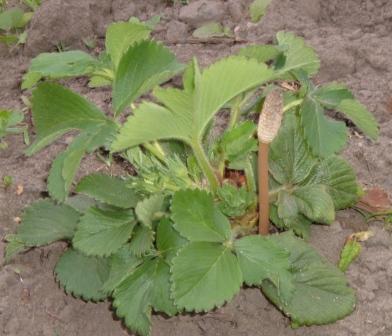
The origins of this plant go back to the Devonian prehistoric period, which took place around 400 million years ago. It a stone age plant which is rooted way down in the soil. It has been documented at a depth of 1.5 metres, (Marshall, 1986) although folklore has it extending still further. Horsetail is a Pteridophyte, which means that it does not form seeds, but spreads underground by extending its subterranean stem and above ground by sending out spores. In April and May it sends up shoots which are stockier, like asparagus. As in the the above picture this Neanderthal beacon like projection contains spoors which are borne like dust on the wind to generate new little horsetail plants. As well as propagating itself from its rhizome roots when split, this alternative to seeds is produced at this early stage of the year. These spores spawn new ferny fronds that link in twos. I wouldn’t think it is quite to be feared as much as that emerging from the deep as it can be dug out and removed early in its career. Nevertheless it does look a bit scary doesn’t it? which shows a different type of growth from the ferny frond usually produced by the same horsetail plants.
Attacking the Horsetail 1 Mowing it
I am an organic gardener, using no chemicals from a point of principle. The most effective way of removing horsetail is to sow grass and regularly mow it. Trials by Ask Organic, which reported to the HDRA ( Gardening Organic) in 2007 suggested that this method will virtually eradicate it, presumably in the combined effect of smothering it and not allowing it to source any nutrition from the sun by continually removing its means of doing so. However, on a vegetable patch this is impractical, and the same study suggested that other methods it tested: biodegradable mulch, impermeable mulch and hoeing were all effective in suppressing it without actually eradicating it.
Reappearance
Attacking the Horsetail 2 Digging it out
The first year I dug down to the subsoil removing all that I could. In some instances it had anchored itself to the clay subsoil, and in many instance it penetrated the sub topsoil so I could go no further. Subsequently I discovered from reading about it that digging it out is futile, anyway, but it was necessary in my case since the subsoil was wall to wall roots and would not have allowed anything else in.
Horsetail growing through the crops
Attacking the Horsetail 3 Pulling it out
Where it has appeared I have dug it out where possible, and if too near the crops I have pulled it out, trying to put my gloved hands into the soil and getting as much of the subterranean growth out as possible. This is time permitting, of course, for it is very time consuming. Hoeing would be easier in some respects, but where it snaps off at ground level it quickly regenerates, and typically it grows adjacent to plants where hoeing is impossible. Where it is not near plants digging or pulling it out seems to be more enduring and effective remedy and is therefore more practicable.
Neanderthal emergence under membrane
Attacking the Horsetail 4 Mulching
Sometimes I employ a water permeable weedproof membrane on some beds rather than leave them bare over winter. If a bed is waiting for transplants in late May I might use one in spring. Tests revealed that mulching did reduce the effectiveness of horsetail, but in my experience the stuff was still actually growing underneath it, and was pushing it up. It did look a bit sickly though.
Reappearance through potatoes
Attacking the Horsetail 5 Competing Plants
Subsequently I have planted crops in an effort to stifle its growth. I have learned which crops are able to compete with it and those which cannot. More robust varieties of vegetables are potatoes, artichokes, concurbits, legumes, corn, while any crops grown from seed have been pointless ( except beetroot and leafbeet which have done rather well), as have been aliums, even when grown from sets. They really don’t like their roots being interfered with, don’t like the competition, and don’t like the poor soil – they produce an even worse crop than other vegetables which also don’t like the impoverished soil. Blackberries don’t seem affected by the horsetail and strawberries are successful. I have fed the soil with organic matter but, on reflection, I think I should have added much more. In between the crops, which I have on raised beds ( without edging ) I have grown companion flowers, mainly pot marigolds, in an effort to help crowd it out. “It does not compete well with other plants in high nutrient conditions. (Andersson and Lundegardh, 1999) To try to provide cover, I have deliberately left these flowers in the ground until the first frost.
One of many bagfuls
Putting the Goodness Back
Received wisdom is that it prefers infertile soil so manuring is a good idea, although it can't possibly get rid of it altogether. It does take silica and other minerals out of the ground, which is why it must be a good idea to put it in heavy duty bags until it rots and then add it to the compost.
Conclusion
Basically, for me, what it comes down to is the question of what I am trying to do. Am I trying to grow things or destroy them, ie am I trying to grow crops or destroy weeds?
People I see around me are trying to do both and are convinced that one is dependent on the other. My experience with tackling horsetail in an organic way is the opposite, that one can grow crops with some weed growth, in fact if one tried to get rid of horsetail in an organic way while still growing crops one would be doomed to failure. By constantly battling against it one can reduce its effect and an essential part of an organic way of achieving this is to grow crops so that they compete for space with the horsetail. Some crops are better than others at doing this and a few are great at competing from seed – the exceptions being big seeded varieties like legumes ( peas and beans), and concurbits and corn, and to a lesser extent onions. Once the horsetail invasion is reduced, beetroot seem to thrive. Otherwise one needs to plant seedlings rather than seeds, so they have a good start.
Providing one is constantly on the lookout for it, like I am at the allotment on my plot least affected by it, and remove it all when seen, it will not gain a hold, since new growth is being formed by spores landing on the surface. Neglected areas like my new plot are far more problematic since the horsetail is established with deep seated root systems. It is this which makes it a long term constant battle.
Postscript
It is a pity those who condemned my new plot as non cultivated in September last year were not better informed. They blithely told me that the meadow of horsetail I took over in 2005 was no worse than any other plot for weeds, than any other plot taken over by a new tenant. I was stunned. I should not have been. These were the same people who saw nothing wrong with inspecting a plot to see if it was cultivated in September, who could not identify wild rocket, thought sorrel was a weed, incorrectly said that both proliferated on the plot and thought there was something wrong with it being a wild mass of nasturtiums and pot marigolds at that time of year.
Update December 2012
When I took over my new plot literally nothing grew on it except horsetail. It is still there, of course, and will always be, but it is nowhere near as strong and matted roots seem to be a thing of the past. As long as I grow crops which can compete with it it doesn’t matter too much. I have had lovely crops of garlic, onions, and shallots from sets; potatoes from seed potatoes; and courgettes, cucumbers, corn, French beans and tomatoes from seedlings. Fruit bushes of all types have given excellent yields, and strawberries have been very successful. Permanent or semi permanent bushes have the disadvantage that they make the removal of horsetail difficult. The only successful plants to grow from seed have been beetroot, peas, broad beans and leaf beet.
Some neighbouring plots use weedkiller on the offending perennial, but I think that containment is sufficient and that complete control is unnecessary. Wisconsin University and Gardening Organic both support my contention that it is impossible to eradicate it by organic methods so that is as good as it gets. It takes a different mindset to learn to live with it, for the traditional mindset is to aim for eradication of weeds. Through my experience with horsetail I have learned that actually the traditional mindset is impossible and those who strive to eradicate weeds are actually embarking on a no win situation anyway. Weeds are spread by seeds which are borne on the wind and if covered by soil to a depth where they cannot germinate they lie in wait to be raised to the surface. Therefore it pays to disturb the soil as little as possible and regular weeding of the plot is always necessary to remove those flying in from elsewhere.
Regularly removing horsetail as it appears takes about as long as this general removal of all the other weeds. It is time consuming, but in a plot such as mine which is riddled with the stuff it is the only known way to do it if you want your veg to be organic. Seven years on I can truly say that I have brought a derelict plot back into cultivation. Last year council representatives recognized this, and commented on horsetail’s obstinacy saying that they used pesticides to weaken and eradicate it. Council representatives admitted that a non cultivation order should not have been issued in 2009, something which was very satisfying, especially since some members of the Allotment Committee were instrumental in pushing for the order to be issued. These individuals are unlikely to listen to reason and have continued to be very unpleasant and even abusive, but it is heartening that their small minded myopia no longer has official backing.













 Pernicious hardly does credit to this, the worst of all the weeds. A perennial, once established it is impossible to eradicate since it regenerates itself from any tiny part of the root or rhizome. Those who have suffered the similar effects of couchgrass and bindweed may disagree about which is the worst, but in my opinion horsetail wins hands down. I reckon it’s impossible to get out, mainly because it goes down so deep, but also because it stores nutrients in little nodes on the rooting system. It sends up shoots which spread laterally in all directions. Since it penetrates way below the topsoil it is impractical to dig it out since to do so would contaminate the topsoil, even supposing you could dig down deep enough. One Sunday afternoon, Alex, a neighbouring plotholder, set out to do this. Two hours later only his head and shoulders could be be seen. Needless to say he gave up the undertaking, so I would not advise his degree of commitment. Know when you're beaten.