

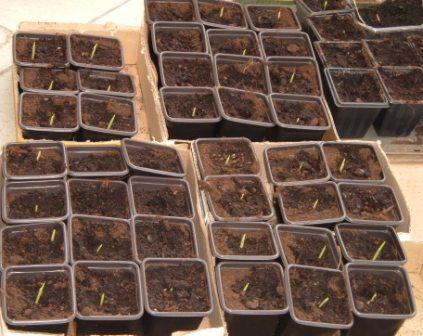
   Planting Out
 One all chances of frost are over they may be hardened of by putting them outside during warmer days and brought in on colder nights. Then they may be planted out into their final resting place, perhaps with the courgettes and cucumbers.  Pollination
 Pollination can be a problem, which is why it is recommended that they are planted in blocks rather than in rows. The plants self fertilise, but for pollination to take place the pollen from the male tassels at the tip of the plants have to make contact with the tassels at the top of the female bit which is the cob that you eat. Every single one of the tassels on the female cob has to be contacted or no new seeds (the tasty bit) will form. This is why sometimes there are gaps in the cob: it is the result of some parts of the cob not being fertilised. To try to avoid this you help the plants as much as possible by planting them in concentrations or blocks rather than strung out in rows. If like me you have a bedded system it is best to use two adjacent beds even if they need to be halved so that you use the ends of two beds for corn and the other ends for other crops.  Favourites
 Favourites I was very happy with Jubilee produced by Mr Fothergills which I picked off the stand in a garden centre. They were fantastic. However, Golden Jubilee had a disappointing flavour the year before last. I tried Mr Fothergill’s Incredible last year which were tasty, although they were an F1 hybrid. Once I find one that is not I will save the seed, hopefully in perpetuity. Golden Bantam, an organic variety, was spindly and ineffectual. Was it my fault or the weather? I don’t know. Double, another organic variety, was not a success. When planting more than one variety it is important to plant them well away from each other for if cross pollination occurs, the crop will be ruined 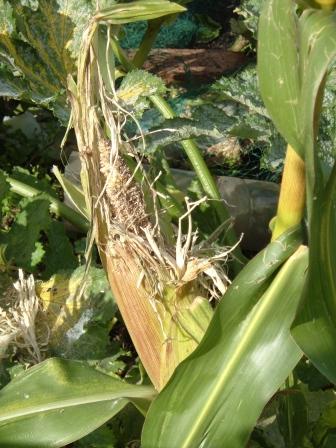 Protecting the crop
A surefire way of telling when the corn is ready is when the squirrels and/or magpies have eaten them. My sister in law remembers that when she lived in Denver, the raccoons fed on the corn grown by her friends. This led me to assume that it is squirrels which are the enemy on the allotment, although I have never seen them feasting on the cobs. It could, however, be magpies that are the culprits, one of my neighbours at the allotment said he has seen them gorging themselves. Either way If you want to avoid the trauma of finding the fruits of your labour decimated, it is a good idea to protect them by throwing netting over the top, which seems to work. To aid ease of netting against the crop being eaten I have started to set the plants in circles of five or six plants so I can tie the tops together when the time comes.
Cooking When I harvest it I will get it into the pan as quickly as I can. It is not a myth that they taste better if you do this. I think the reason is to do with a lot of the sugar converting to starch once the cob is separated from the stalk. 

|

 Perfect Companions
The Three Sisters were corn, beans and squash, but the principle works just as well with courgettes or cucumbers since they are the same family as Squash: concurbits. The corn provides a climbing stalk for the beans; the beans provide nitrogen to the soil to nourish the corn; and the large leaves of the concurbit, spread out, helping to preserve the moisture in the soil by stopping it evaporating so readily, and preventing weeds from growing to compete with the corn and beans. They are the perfect companions, for one spreads horizontally while the others vertically, and the beans will use the corn stalk for support without impeding the growth and formation of the husks of corn.  From the New World
Early English settlers in the seventeenth century were given not only food, but were shown the method of cultivation by the native Americans. For example it is doubtful if puritans in Plymouth, (now situated in Massachusetts) would have survived if they had not been helped in this way by the Wapanoag ( meaning people of the dawn ie east).
 Harvesting
 When the tassels shrivel and the cobs are golden it is worth testing to see if they are ready to eat. I do this by pulling back the outer layer and pressing a thumbnail into a kernel. It is ripe if a milky juice comes out.   |
url http://www.digmyplot.co.uk
©may 2009
©may 2011